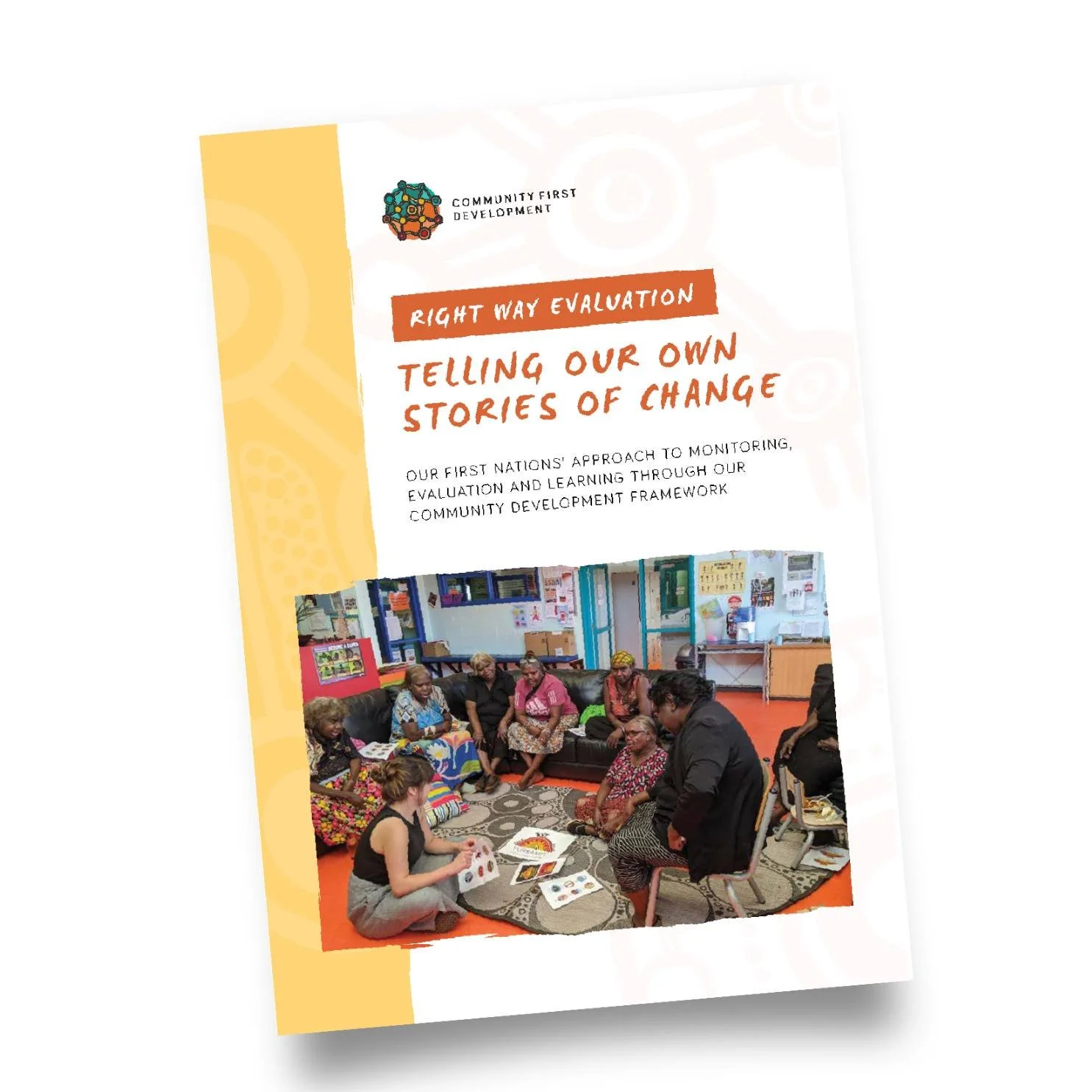
RIGHT WAY EVALUATION
OUR FIRST NATIONS' APPROACH TO MONITORING, EVALUATION AND LEARNING
Correct citation:
If you’re referencing this guide in your own work, here’s the correct way to cite it:
Community First Development, Right Way Evaluation: Telling our own stories of change, 2025
DOWNLOAD THE GUIDE
Fill in the form below to access and download the guide:
WHY RIGHT WAY EVALUATION
Too often, evaluation is done using frameworks that don’t reflect what’s most important to First Nations’ people.
When we ignore what’s most important, we not only miss the full story, but we also risk drawing the wrong conclusions entirely.
Without trust and genuine relationships, even well-intentioned work can lead to outcomes that don’t reflect what communities actually need, want, or define as success. And when communities aren’t leading the conversation, evaluation becomes just another extractive process, not a tool for learning and growth.
If evaluation doesn’t include First Nations’ voices throughout the process, it’s not just ineffective, it’s part of the problem.
RIGHT WAY EVALUATION CREATES
Time and space for reflection
Opportunity for generating discussion (yarning, storytelling and sharing, deep listening)
Engagement in ‘explicit’ thinking aloud.
THE EVALUATION JOURNEY
In Right Way Evaluation, Community and Community First Development are connected through journey lines moving in both directions.
The community and its dream are held by Elders, community members and youth, supported by community knowledge, assets, expertise, culture and land-based practices.
The journey with Community First Development starts with understanding a community and its dream, and the dream indicators that are linked to community-led projects and activities (stepping stones to achieve the dream).
Projects and project indicators are developed, where communities define success. Through monitoring, reflection and celebration, all the activities and indicators are tracked and obstacles and red tape are overcome. Through all these stages, Community First Development is contributing to Story of Chance outcomes.
RIGHT WAY EVALUATION DOES NOT SIT IN ISOLATION AS AN EXTERNALLY IMPOSED ACTIVITY
It is embedded at each stage within our Community Development Framework, from the first conversation through to project completion and beyond.
“… monitoring and evaluation should be different for First Nations, because you can write anything on a piece of paper, but [it doesn’t mean much] without relationships and actually seeing the impacts yourself. And it takes time. Evaluation takes time…”